

At 2 a.m., you're feeding a restless baby with one hand and scrolling through nursing bras with the other. Your breasts feel heavy, your skin is tender, your old size is useless, and every product page promises a different version of “support.” You need easy access, room for fluctuations, and enough structure to leave the house without feeling wrapped in shapeless fabric.
The right answer isn't one magical bra for the entire postpartum journey. Your needs change from the first days of engorgement to the later months, when you may want lift, polish, and a visible return to your own style. This guide gives you a practical path through the best postpartum bras, from soft early-stage essentials to elegant structured nursing lingerie.
Why Postpartum Bra Shopping Feels So Overwhelming
You are comparing bras online after a long day, while your rib cage, breast fullness, and comfort needs keep changing. A pre-pregnancy bra may feel tight around the ribs, shallow in the cups, or impossible to open with one hand during a feed. Size charts rarely settle the question because measurements can shift between morning, feeding, pumping, and evening.
The confusion has a practical cause. A 2024 study of maternity and nursing sports bras found that only 15% of purchasers found exactly what they wanted. Support, design, and fit were the main complaints, while 94% and 98% of participants identified support and comfort as priorities. The study on current maternity and nursing sports bras shows why a convenient drop-down cup is only one part of a successful bra.

Your old size is a starting point, not a verdict
A postpartum bra must accommodate changing rib-cage measurements, breast fullness, tenderness, leakage, and daily movement. Treat it as a staged wardrobe decision, not a one-time purchase.
- Early recovery: Choose softness, stretch, and room for fluctuations.
- Daily rebuilding: Add a firmer wireless bra as your body becomes less reactive.
- Later postpartum: Choose structured nursing bras when you want dependable lift and a more polished silhouette.
A clinical bra-fit study found that 85% of women were wearing ill-fitting bras, and self-selected sizes differed significantly from correct sizes, with p<0.001. This finding supports a clear rule: your old size cannot decide your postpartum fit.
You are not failing at shopping. You are solving several fit problems at once. Identify your current postpartum stage, then choose the structure that suits your body today. In the later months, that may mean leaving basic comfort bras behind for an elegant, supportive style that helps you recognise yourself again.
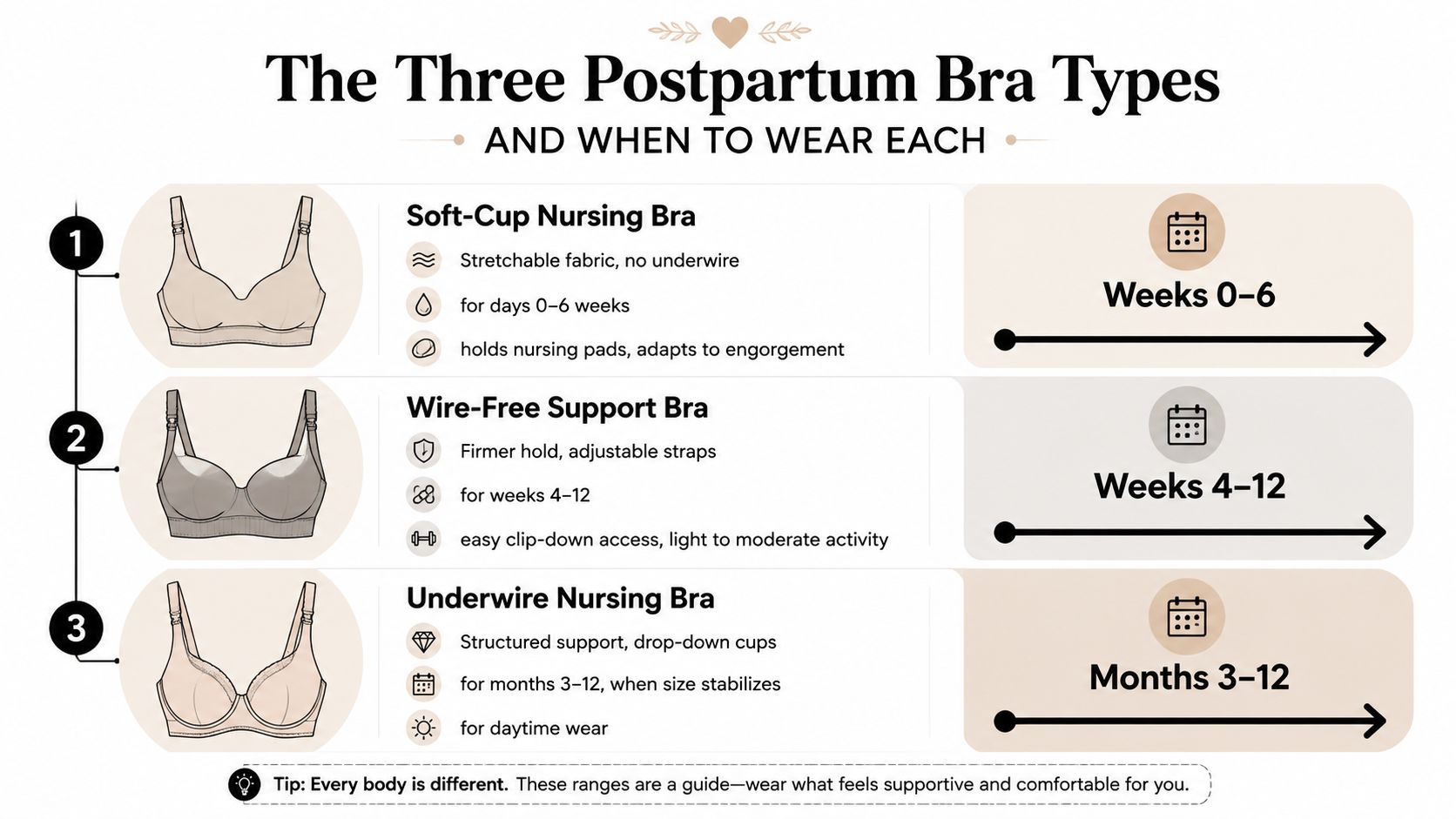
The Three Postpartum Bra Types and When to Wear Each
The best postpartum bras fall into three practical groups. The timelines overlap, so use your physical markers rather than treating the dates as strict rules.
Soft-cup nursing bras for the earliest days
During the first weeks 0 to 6, choose a soft-cup nursing bra with stretch fabric, a forgiving underband, and a clip-down cup that opens easily with one hand. This is the stage when engorgement and feeding patterns can make your breast volume change quickly. A rigid, closely fitted cup can feel restrictive when your body needs adaptability.
Look for:
- Soft seams that don't press into sensitive skin.
- Enough cup depth for nursing pads.
- Wide, stable straps.
- A band that supports without compressing.
- Clips that release smoothly while you hold your baby.
You're ready to consider a firmer bra when the current style feels loose after feeding, shifts during normal movement, or no longer gives enough lift for daytime clothing. Don't switch just because you're tired of soft bras. If your breasts still feel tender or fluctuate sharply, flexibility matters more than shaping.
A soft, elegant option such as GAIA combines stretch lace, flexible support, and breastfeeding access, making that balance more considered than a basic sleep bralette.
Supportive wireless nursing bras for the transition
From roughly weeks 6 to 12, many mothers want more hold for errands, walks, and longer periods upright. A supportive wireless nursing bra uses a stronger band, shaped panels, adjustable straps, and better side support without placing an underwire against sensitive tissue.
The signal to move into this category is practical: your breasts feel less unpredictable, you're spending more time active, and your soft-cup bra no longer keeps your shape stable under clothing. The common mistake is choosing a wireless style that's only soft, with no real engineering in the band or lower cup.
Structured and underwire nursing bras for later postpartum
From around month 3 onward, structured or underwire nursing bras become useful when your size has settled enough for a more exact fit. They're the right choice for workwear, social clothing, fuller bust support, and any moment when you want your lingerie to look intentional.
Wait if the underwire presses on breast tissue, leaves red marks, or feels restrictive during feeding changes. Readiness means the wire sits around, not on, the breast, the band stays level, and the drop-down mechanism remains easy to operate.
How Your Body Changes and What That Means for Fit
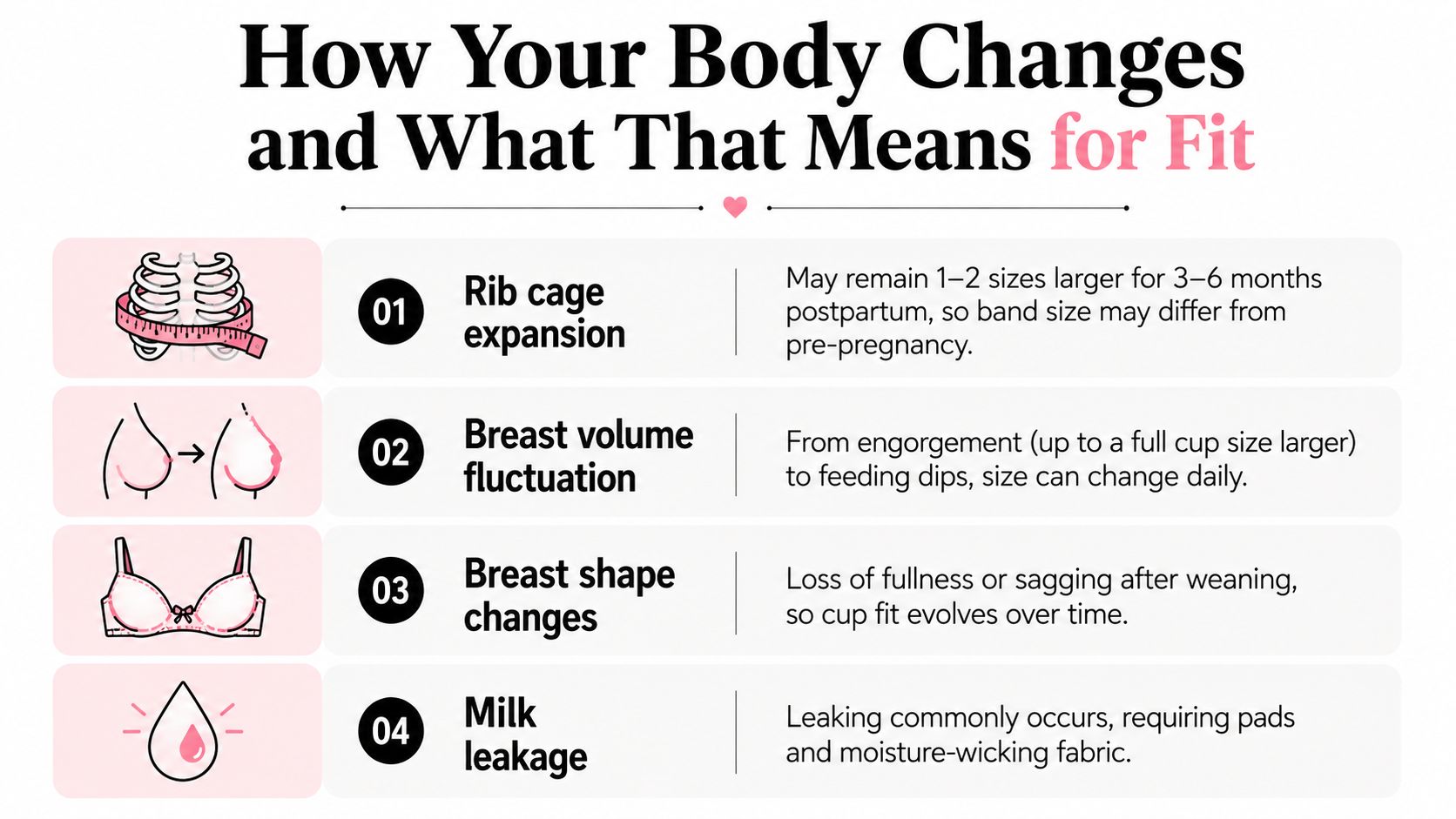
Pregnancy and breastfeeding alter more than cup volume. The rib cage may remain broader for a while, breast fullness can change around feeding, and weight distribution can shift the balance between band and cup measurements. A bra that fits comfortably at one stage may feel wrong later even when your body weight hasn't changed.
A postpartum-focused survey of 323 women found that self-reported UK bra size increased by an average of one underband and two cup sizes from before, during, and after pregnancy. The research examining postpartum bra-size changes explains why your pre-pregnancy size shouldn't control your postpartum purchase.
What an incorrect size looks like
Poor fit usually announces itself through specific symptoms:
- A band that rides up often isn't providing enough tension around the torso.
- Cup spillage means the breast isn't fully contained, whether from insufficient cup volume or a shape mismatch.
- Gaps in the cup can indicate excess room, but they can also appear when the cup shape doesn't follow your breast.
- Straps that dig in may be carrying too much weight because the band isn't doing enough work.
- Wire pressure is a warning that the underwire is sitting on breast tissue rather than surrounding it.
The solution isn't always to size up everywhere. A larger cup with the same band, a different band with a related cup volume, or a more flexible style may solve the actual problem.
Support affects more than appearance
Posture deserves attention. In a bra-support study, all participants failed fit assessment in their usual bra, and 67% failed even in the test bra. The research also found immediate biomechanical changes in posture when support improved. The bra-support study indexed by PubMed gives a useful perspective: a supportive bra can influence how your body carries breast weight during everyday movement.
Fabric matters too. In a clinical bra-fabric study, a bamboo-mix fabric achieved horizontal wicking at 34.7 mm/s, compared with 29.1 mm/s for 100% cotton. In a double-layer test, its mean resistance was 10 m²·Pa/W, compared with 11.5 m²·Pa/W for cotton. The clinical textile study supports choosing materials that combine moisture management with airflow, especially when leakage and frequent skin contact are part of your routine.
Comparing Support Access Materials and Style Across Bra Types
No postpartum bra wins every category. A soft wireless bra is excellent for rest and fluctuations, while a structured or underwire style is better when you need lift, clothing compatibility, and a polished outline.
| Feature | Wireless Nursing | Structured Support | Underwire Nursing |
|---|---|---|---|
| Support level | Light to moderate, depending on band engineering | Moderate to strong | Strongest shaping and lift |
| Nursing access | Usually pull-aside or clip-down | Clip-down or drop-down cups | Discreet drop-down cups |
| Best materials | Stretch cotton blends, seamless knits, moisture-managing fabrics | Breathable stretch fabric with reinforced panels | Structured stretch lace, molded or shaped cups, supportive lining |
| Best use | Sleep, overnight feeds, early fluctuations | Daily errands, active days, transitional routines | Work, outings, polished outfits, later postpartum |
| Main advantage | Flexibility and comfort | Balance between comfort and support | Stable lift and refined silhouette |
| Main limitation | Can lack lift for heavier breasts | May feel too firm during rapid fluctuations | Requires more exact fit and careful wire placement |
Wireless nursing bras
Wireless styles prioritize softness and adaptability. They're the sensible choice for overnight feeds, early engorgement, and days when your breasts don't tolerate pressure well. Choose one with a broad underband and internal support panels, not a thin elastic strip that stretches around the body.
A smooth finish can help under fitted tops, while cotton blends may suit sensitive skin. For a closer look at how fiber choice affects comfort and performance, use this guide to bra fabric and material.
Structured support bras
Structured wireless bras bridge the gap between a lounge bralette and a traditional bra. They often use firmer lower cups, side panels, adjustable straps, and a more defined band to keep breast weight supported during active days with a toddler.
This is the category I recommend for mothers who are leaving the house regularly but aren't ready for underwire. It works well under knit dresses, casual shirts, and everyday tops because it provides shape without demanding a fully stabilized fit.
Underwire nursing bras
Underwire nursing bras are the strongest option for lift and separation, particularly for heavier, milk-filled breasts. Expert testing of nursing bras consistently distinguishes reinforced bands and underwire construction as stronger choices for stability, while wire-free bras better accommodate flexibility and fluctuations. Wirecutter's nursing-bra testing reinforces the need to match structure to use, rather than treating underwire as automatically right or wrong.
Use this style for professional clothing, special occasions, and later postpartum days when you want your silhouette to look deliberate. The wire must sit outside the breast tissue, and the cup should open without forcing you to remove the entire bra.
How to Measure and Choose Your Postpartum Bra Size
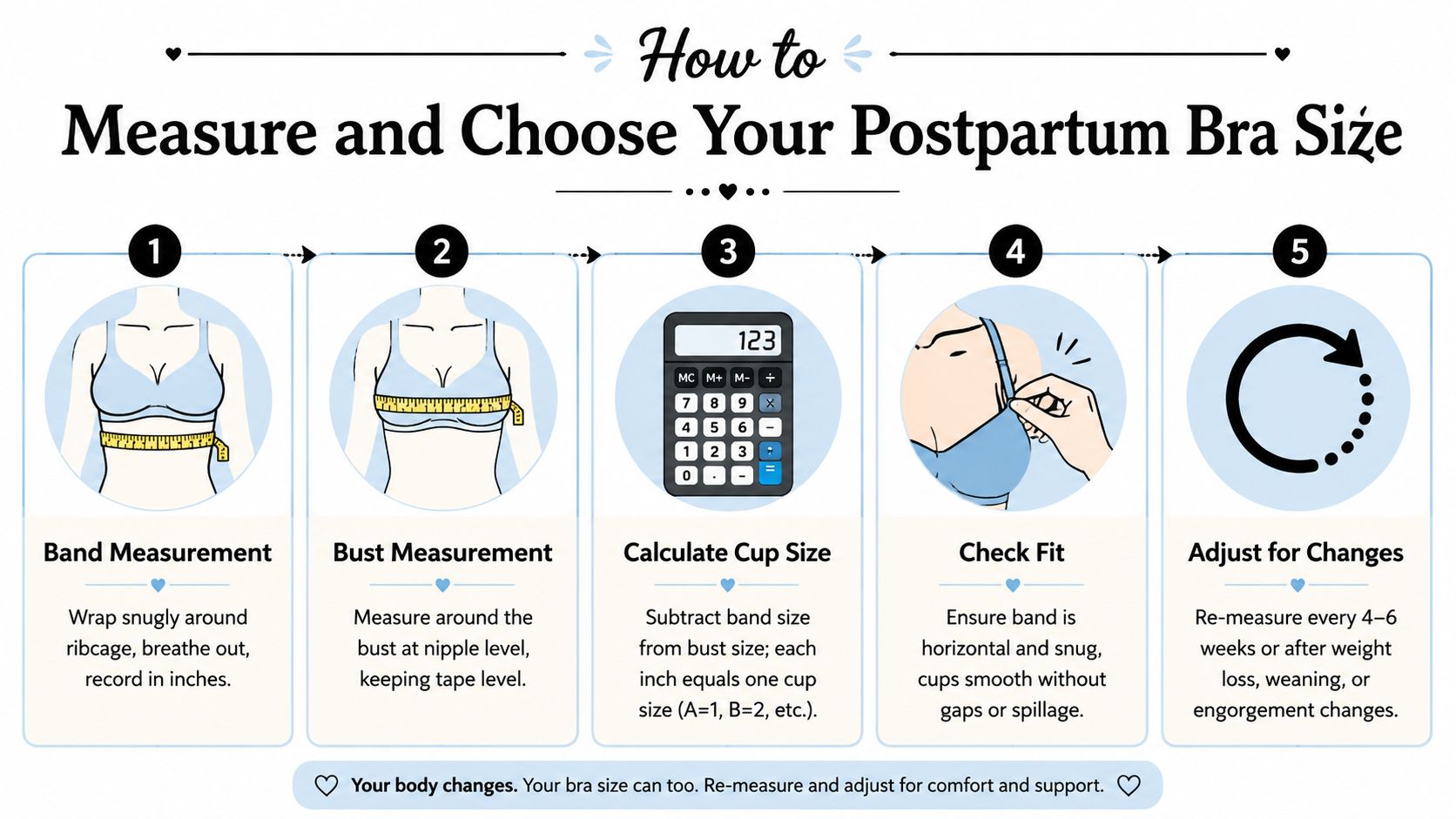
Measure your current body, not your old label. Because pregnancy can change the rib cage and breastfeeding can alter fullness throughout the day, a pre-pregnancy size is only a reference point.
Take the band measurement first
Stand upright and wrap a soft tape measure snugly around your rib cage, directly beneath the bust. Keep the tape level across your back, breathe normally, and record the measurement without pulling so tightly that it digs in.
The band should feel firm because it provides much of the bra's support. If it rides upward between your shoulder blades, it's too loose or has lost elasticity. If it creates sharp pressure or restricts comfortable breathing, try a larger band or a more flexible construction.
Measure the fullest part of the bust
Measure around the fullest part of your breasts, keeping the tape level and relaxed. Then lean forward and repeat the measurement. The forward measurement can reveal volume that an upright measurement misses, which is particularly useful when breast fullness changes with feeding.
Subtract the band measurement from the bust measurement. Traditional sizing systems use the difference to estimate cup size, but brand charts vary, so treat the calculation as a starting point rather than a final answer.
- Measure when comfortable: Avoid taking your primary measurement at the peak of engorgement.
- Compare both positions: Upright and leaning measurements show how your volume behaves.
- Check the bra on your body: A correct calculation can still produce the wrong shape.
- Use the loosest hook initially: A new bra should have room to tighten as the band relaxes.
Remeasure regularly during the early months and after noticeable changes in feeding, weight, or fullness. The nursing-bra measuring guide can help you check each part of the process before ordering.
Judge the fit by movement
Raise your arms, bend forward, sit down, and open the nursing clasp. The band should remain horizontal, the cups should fully contain the breasts, and the straps shouldn't carry the entire load.
If you're between sizes, prioritize breast containment and comfortable breathing. During active breastfeeding, a little extra cup room is generally more useful than a cup that presses into changing tissue, but excess fabric shouldn't pool or fold.
Elevating Your Postpartum Wardrobe with Structured Elegance
The later postpartum stage deserves its own lingerie strategy. Once your daily fluctuations feel more predictable, you may still be nursing, but you're also returning to work, meeting friends, dressing for events, or wanting to recognize yourself in the mirror again.
Comfort remains important, but it no longer has to mean softness without shape. A structured bra can support your breasts while giving a blouse, dress, or fitted knit a cleaner line. It can also change how you carry yourself because you're no longer treating your body as temporary or secondary.
Choose structure for the life you're rebuilding
Look for three design details:
- A stable lower cup: This anchors breast weight instead of leaving the straps to do all the work.
- Thoughtful strap placement: Straps should stay secure without cutting into the shoulders or slipping outward.
- Functional nursing access: The cup should release smoothly while maintaining support when closed.
The transition is less about abandoning nursing bras and more about choosing one that belongs in your complete wardrobe. A bra can remain breastfeeding-compatible while looking like lingerie you selected for yourself, not merely equipment you accepted because it was practical.
For guidance on matching neckline, coverage, silhouette, and outfit needs, use this bra style guide.
GAIA and PETRA for a more polished stage
Milk&Lace's GAIA and PETRA designs are positioned for later postpartum wear, with structured support, soft lace, and discreet nursing functionality. PETRA features ultra-soft stretch lace, gentle underwire, and one-hand nursing access. Those details make it suited to mothers who want more shaping and an elegant appearance without giving up feeding access.
The strongest reason to add a structured nursing bra is emotional as much as practical. Your identity didn't disappear when motherhood began, and your lingerie shouldn't suggest that beauty, sensuality, or personal style must wait until breastfeeding ends.
Care Tips Troubleshooting and Final Recommendations
Postpartum bras work hard, so care affects how long their bands, clips, lace, and straps remain dependable. Hand-wash delicate nursing clips when possible, avoid high heat on elastic, and rotate your bras instead of wearing the same one every day. A small working wardrobe is easier to maintain when each piece gets time to recover between wears.
Fix the common fit problems
- Straps slip: Tighten them gradually, then check whether the band has become too loose. If the band rides up, remeasure rather than over-tightening the straps.
- Band rides up: Move to a firmer setting or reassess the band size. A level band should stay stable as you move.
- Cups spill: Try more cup room or a different cup shape. Don't solve breast overflow by tightening the straps.
- Clips snag: Clean the hardware gently and inspect the clasp. Replace the bra if the mechanism loosens or no longer closes securely.
- Wire presses: Stop wearing that style until the wire sits around the breast tissue rather than on it.
Practical rule: If the bra causes persistent pain, pressure, or breast-tissue compression, change the style and seek professional guidance when needed.
Your final wardrobe should be tiered:
- Immediate recovery: Soft-cup nursing bras for flexibility, leakage management, and rest.
- Transitional weeks: Supportive wireless bras for daily movement and moderate structure.
- Later postpartum: Structured or underwire nursing bras for lift, workwear, social dressing, and confidence.
A properly fitted bra isn't vanity. It supports comfort, posture, movement, and the emotional work of reconnecting with yourself after birth.
Milk&Lace offers structured nursing lingerie designed for later postpartum months, including soft lace, reliable support, and discreet breastfeeding access. Visit Milk&Lace to explore options that help you dress for motherhood without setting your personal style aside.