

You're up in the dark, one hand on a warm bottle, the other trying to keep your shoulders from creeping up toward your ears. Your baby is hungry, your own body still feels tender and unfamiliar, and you just want this feed to feel calmer than the last one. The best bottle feeding position isn't about perfect posture, it's about finding a hold that keeps your baby safe while letting you breathe, soften, and settle into the moment too.
There's a real rhythm to bottle feeding, and it usually shows up slowly. One night you notice your baby swallowing more smoothly when their head is a little higher. Another day your back reminds you that leaning forward for every feed isn't sustainable. The right position becomes the one that protects your baby's airway, supports steady milk flow, and doesn't leave you aching at the end of the feed.
Finding Your Rhythm in the Quiet Moments
At 2 a.m., the nursery can feel both intimate and overwhelming. Your baby stirs, you reach for the bottle, and suddenly you're balancing hunger, sleep deprivation, and the tiny pressure of wanting to “do it right.” That's a lot for one feed.
The good news is that bottle feeding is a learned rhythm, not a performance. You and your baby are figuring out a shared pace, and that pace can change from one feed to the next. Some feeds want closeness and stillness, others need a more upright hold and a slower flow, and some nights call for whatever keeps both of you comfortable enough to get through it gently.
Practical rule: if you're tense, hunched, or rushing, your body is making the feed harder than it needs to be. Settle yourself first, then settle the baby.
A soft, safe feeding routine often starts with permission to adjust. You don't need to cling to one exact hold if your baby's cues, your incision, your shoulders, or your tired arms are asking for something different. A feed can still be loving, responsive, and technically sound even when it's not graceful.
That's why the search for the best bottle feeding position is really a search for the position that helps both bodies cooperate. When your baby can swallow comfortably and you can hold them without strain, feeding stops feeling like a test and starts feeling like care.
The Foundations of a Safe and Peaceful Feed

The safest bottle feeds begin with three basics. Keep your baby's head above their stomach, support the head, neck, and body in one line, and let the milk flow in a way your baby can control. Major pediatric guidance consistently recommends a semi-upright or head-above-stomach position for routine bottle feeding because it helps reduce choking risk and supports safer swallowing, with the CDC, NHS, and Nationwide Children's Hospital all pointing caregivers toward that posture Nationwide Children's Hospital guidance.
The second piece is the bottle itself. A bottle held too steeply can let gravity do the work, and that means faster flow than many babies can handle. Brigham and Women's Hospital recommends horizontal milk flow and notes that a vertically held bottle increases flow speed, which is why the bottle should usually stay horizontal or nearly horizontal while the baby stays semi-upright or side-lying Brigham and Women's Hospital flowchart.
The third piece is the room around you. Dim light, fewer interruptions, and a calm pace help both of you stay regulated. If you're warming milk ahead of time, it also helps to know how long it stays appropriate to use, so you're not second-guessing the bottle while your baby is already waiting, and this guide on warmed breast milk timing can help you keep that part simple.
A steady setup matters more than a perfect-looking hold. Support your baby close to your body, keep their chin free, and watch for the feed to feel organized rather than rushed. When the posture is right, swallowing looks easier, breathing looks quieter, and your own hands can stop compensating for a poor angle.
Before you even think about technique, check the fit of your space. Are your feet planted? Is your back supported? Is your baby high enough that you aren't curling over them? Those small details protect both safety and stamina.
Exploring Four Comfortable Bottle Feeding Positions
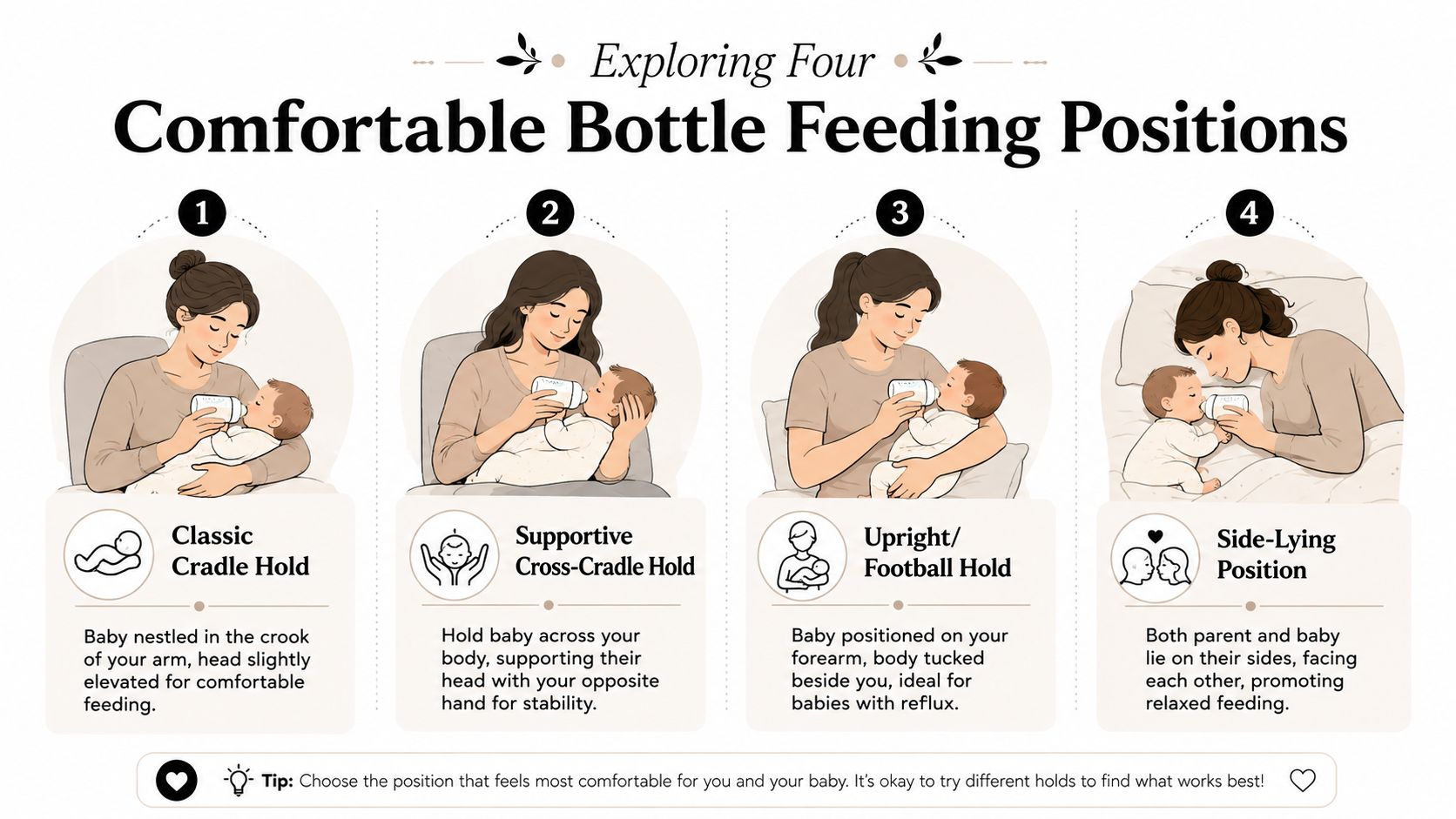
A feed often goes better when the hold fits the moment. A newborn who needs close head support, a parent recovering from birth, and a baby who settles more easily in a quieter angle may all need something different. The right position is usually the one that keeps the baby steady while also keeping your own body from tensing up.
Classic Cradle Hold
This is the hold many parents try first because it feels familiar and close. Baby rests in the crook of your elbow, their body lies along your forearm, their head stays slightly raised, and your free hand steadies the bottle. It suits feeds that are calm and settled, especially when you want skin-to-skin closeness and a simple setup.
The trade-off is your posture. If your elbow sinks too low or your shoulders round forward, your neck and upper back start doing extra work. Keep your baby high enough that you are not folding toward them, and keep the bottle angle steady so the milk does not pour in too quickly.
Supportive Cross-Cradle Hold
Cross-cradle gives you more control over the baby's head and neck, which can be helpful with tiny newborns or babies who need a little more guidance at the start of a feed. You support the baby with the arm opposite your bottle hand, and that leaves your dominant hand free to adjust the nipple and the pace.
It can be especially useful when the feed feels unsteady or the baby keeps slipping away from the nipple. The hold asks for more active handling than the classic cradle, but that extra attention often makes the feed feel more organized.
Upright or Football Hold
This position often helps when your own body needs relief. Baby is tucked beside you, supported along your forearm or against your side, which can feel kinder after birth or on days when lap pressure is uncomfortable. It also suits babies who do better when they are more upright during a feed.
Many parents choose this hold because it keeps the baby close without asking them to hunch over the bottle. That matters on long days, especially when your back or abdomen is already carrying enough strain.
Side-Lying Position
Side-lying can feel gentle for both of you when the baby is aligned well and the feed is closely supervised. The baby lies on their side, facing you, with the head and body in one line, while you guide the bottle so the flow stays more baby-led than gravity-led. A clinical study on side-lying feeding reported benefits in preterm infants, including better intake and steadier feeding responses in side-lying positions.
That evidence matters most for fragile or premature babies, but the practical point is wider than the NICU. Side-lying can support pacing, reduce rushing, and give the feeder a chance to slow the rhythm instead of letting the bottle do the work.
| Position | Best For | Key Benefit |
|---|---|---|
| Classic Cradle Hold | Calm routine feeds, closeness | Familiar, soothing, easy to maintain |
| Supportive Cross-Cradle Hold | Newborns, latch organization | More control over the head and nipple placement |
| Upright or Football Hold | C-section recovery, body comfort | Reduces pressure on the abdomen and lap |
| Side-Lying Position | Pacing, preterm babies, slower feeds | Helps the baby control milk flow more directly |
If you use bottles often, consistency helps. A practical guide like this one on 8 oz baby bottles can make it easier to choose gear that fits your routine without crowding the feeding area.
Your Comfort Matters Too Posture and Support
A good feeding position should protect your baby, and it should also spare your body. If your neck is craning, your lower back is tightening, or your shoulders are bracing every time the bottle comes out, the hold is asking too much of you. Comfort is part of what makes repeated feeds workable, especially in those early postpartum days when your own body is still recovering.
Start with your chair. Choose one with a backrest, plant both feet on the floor if you can, and bring the baby to you rather than folding yourself toward the baby. Pillows can help, but only if they lift your baby to the right height and keep your arms from drifting into an awkward angle.
A supportive pillow under your forearms can make longer feeds easier to sustain. Relaxed shoulders and a soft jaw matter too. When your upper body settles, your hands usually become steadier, and the whole feed tends to feel less strained.
Your clothing matters in the same way. Postpartum dressing is about coverage and function, but it also affects how supported and calm you feel during a feed. A bra that holds without digging in can change the experience from the first reach for the bottle to the last burp. Milk&Lace also offers the GAIA nursing bra, which combines nursing access with structured support, and that kind of design can be useful when you want comfort that still feels polished.
If you're constantly shifting, readjusting, or bracing your back, the position needs more support, not more willpower. If you're struggling with aches, postpartum back pain relief strategies can make a meaningful difference alongside better feeding posture.
When your body feels held, you can focus more fully on your baby's cues. That changes the whole feed, because less energy goes into coping with the position and more can go into the quiet connection of the moment.
Paced Feeding and Adapting to Your Baby's Needs
A feed can start smoothly and still drift into gulping if the milk flows too quickly. Paced bottle feeding keeps the baby at the center of the rhythm, with pauses built in so they can swallow, breathe, and decide when they have had enough. The practical setup is straightforward, use a slow-flow nipple, keep the baby more upright, let the nipple touch the lips gently, hold the bottle parallel to the floor, and tip it down for a short break when the sucking becomes continuous instead of rhythmic paced feeding technique guidance.
That slower pace helps for more than comfort. It reduces the chance of your baby swallowing air just to keep up, and it gives you a clearer read on their cues before they become upset or overtired. Many parents notice that feeds feel calmer once the bottle stops driving the pace.
How to do it well
Start with a stable position that also lets your own body stay relaxed. Bring the nipple to your baby without pushing it in, then keep the bottle only slightly tipped so the nipple stays filled without flooding the mouth. If sucking turns frantic or nonstop, lower the bottle briefly and let your baby reset before offering it again.
Burping halfway through the feed and again at the end can help if your baby is squirmy, arching, or pulling off the bottle with a tight expression. If your baby was born premature or has medical needs, side-lying can give a steadier base for paced feeding because it can help the infant manage flow more directly, and the clinical study on side-lying feeding supports that approach in preterm infants clinical study on side-lying feeding.
How to adjust for different needs
Reflux-prone babies usually do better when they stay upright during the feed and remain upright for a while afterward. Babies who seem overwhelmed often need the flow slowed first, before you change every part of the setup. Babies who swallow a lot of air usually need the bottle angle lowered before you assume the formula or nipple type is the problem.
The part that confuses caregivers most is hearing two instructions at once, keep the baby upright and keep the bottle horizontal. Those instructions work together. The baby stays semi-upright, while the bottle stays horizontal or nearly horizontal so the infant, not gravity, controls the milk flow NHS bottle-feeding guidance.
Once that feels familiar, the method becomes easier to trust. The baby stays supported, the bottle stays gentle, and the pauses give you room to notice what your baby needs without forcing the feed into a rushed rhythm.
Troubleshooting Common Feeding Challenges
If your baby gulps, dribbles milk, or seems unsettled halfway through a feed, start with the angle and the amount of support you are giving. Too much tilt can send milk too quickly, and a fast flow often leads to air swallowing, coughing, or a baby who finishes the feed looking strained instead of settled. A calmer hold usually works better than a firmer grip.
The upright-versus-horizontal confusion comes up often, and it makes sense. The baby should stay semi-upright, while the bottle stays horizontal or nearly horizontal so the baby controls the milk flow, not gravity. When those two pieces work together, the feed usually feels slower, steadier, and more organized.
If your baby turns away, arches, or fusses at the bottle, pause before pushing ahead. A brief burp, a slower nipple, or a softer reset in position often helps more than adding pressure. If the baby seems sleepy and keeps losing focus, the flow may be too slow, but it can also mean they need a break rather than more milk.
Your own comfort matters in these moments too. If your shoulders are lifted, your wrists are bent, or your back is starting to ache, that strain makes it harder to stay patient and read your baby's cues clearly. A pillow, a better seat, or a small shift in your arm support can make the feed easier to repeat later.
A good feeding routine is not built on one perfect hold. It comes from responsiveness, patience, and a willingness to notice what your baby and your body are telling you. If the feed feels gentle, manageable, and comfortable enough to repeat tomorrow, you have found something that works.
If you want nursing pieces that support your body while you settle into these bottle-feeding rhythms, explore Milk&Lace. Their maternity and nursing bras are made for comfort, access, and a more put-together postpartum feel, which can make long feeding days feel a little more like yours again.