

You're home, the baby only settles when they're pressed right against you, and the wrap on the dresser looks both comforting and suspicious. That's the whole postpartum paradox after a cesarean, you need closeness, but your incision still feels like it runs the whole show. The smart move is not to treat every “baby wrap” as the same thing. One thing is for carrying the baby, another is for supporting your own abdomen, and mixing them up causes a lot of unnecessary fear.
The Question Almost Every C-Section Mom Asks
A lot of mothers ask the question in the wrong way. They type baby wrap after c section into Google and end up staring at a pile of advice that blends babywearing, belly binding, and postpartum shapewear into one messy answer. That's why the same search can leave you more confused than when you started.
Two products, two jobs
A baby wrap used for babywearing holds your baby close to your chest. A postpartum abdominal binder or belly wrap supports your own incision and lower abdomen. Those are not interchangeable, and they shouldn't be treated like they solve the same problem.
That distinction matters because the medical literature on binders is about early recovery support, not body shaping. A 2024 meta-analysis of 13 randomized controlled trials found that abdominal binders after cesarean delivery reduced pain at 6, 12, 24, and 48 hours, improved walking at 8, 12, and 24 hours, and lowered symptom-distress scores at 24 and 48 hours versus controls, while the same review notes that about 21% of women report moderate to severe pain after cesarean birth, and poor pain control can slow a return to routine and lengthen the hospital stay. The point is simple, support helps when it's timed and fitted well, but the evidence is about symptom relief, not changing your body shape. See the clinical summary in the review on postoperative abdominal binders and wound care here.
A wrapped baby can help too, but that's a different decision. The practical question is not, “Am I allowed to wrap?” It's, “Do I need babywearing, incision support, or both, and which one fits my body today?”
Practical rule: If the fabric is pressing on your incision, it's the wrong setup. Comfort first, always.
When It Is Safe to Start Wrapping
Forget the neat little timeline people love to repeat. Recovery after a C-section is not on a calendar, it's on your body, your incision, and the way walking feels when you try it. That's the only honest way to make the call.
Readiness is about symptoms, not a date
Start by asking four plain questions. Does movement still cause sharp pain? Is the incision closed and dry? Can you stand and walk without bracing your stomach? Can you lift and settle your baby without feeling your whole core seize up?
If the answer is yes to those questions, you may be ready for short, careful use. If the answer is no to even one of them, wait or scale back. That's not failure, that's good recovery logic.
The reason to pay attention early is that mobility matters. The review above found that binders improved walking in the first two days after surgery, and one included study reported that women wearing a binder at 8 hours post-op walked 99.4 ± 27.3 m versus 81.0 ± 22.2 m in controls, roughly a 20% increase in walking distance. Early support can help you move more smoothly, but it should still feel gentle and controlled, not forced.
Here's the blunt version. Use wrapping when it helps you move and breathe easier. Stop and wait when it makes you guard, grimace, or hold your breath.
When to pause and call your provider
- Infection signs: If the incision looks red, draining, or increasingly swollen, stop and get medical guidance.
- Incision separation: If the edges are opening or look unstable, don't wrap until your provider clears you.
- Sudden dizziness: If you feel faint or shaky when standing, don't try to power through it.
- Pain that spikes with movement: If babywearing increases pain instead of reducing strain, your body is telling you it's too soon.
That symptom-based approach is more useful than any blanket promise about “two to four weeks.” Some mothers are comfortable earlier, others need longer. Both can be normal.
Choosing a Wrap That Respects Your Incision
Not every carrier is kind to a healing abdomen. The main issue is where the pressure lands, and whether you can put it on without twisting, tightening, and fighting your own body. That's why a soft wrap and a structured carrier can feel completely different after surgery.
For incision-friendly recovery, I'd rank the options by how much control they give you over pressure. A stretchy wrap or ring sling usually gives the most flexibility. A structured carrier can work later, but only if the waistband sits high enough to miss the incision and doesn't dig when you sit.
The incision location and swelling also matter. If your lower belly feels tender or puffy, any thick band right across that area is asking for irritation. A useful visual reference for incision and swelling basics is this guide on C-section incision swelling, because fit around the scar is the whole game here.
| Type | Pressure on Incision | Learning Curve | Best Recovery Stage |
|---|---|---|---|
| Stretchy wrap | Low when worn high and snug | Moderate | Early recovery if movement feels steady |
| Woven wrap | Low to moderate, depends on technique | Higher | When you're confident tying and adjusting |
| Structured carrier | Variable, waistband can press on scar | Lower to moderate | Later, or only if worn high enough to avoid the incision |
A few hard truths help here. Stiff waistbands that sit right on a bikini-line incision are a bad idea early on. Buckles that dig when you sit are another dealbreaker. If you need to keep yanking at the carrier once it's on, it's not the right fit for this stage.
My opinion: soft and adjustable beats rigid and “supportive” every time in the first stretch after surgery.
Putting On the Wrap Without Hurting Yourself
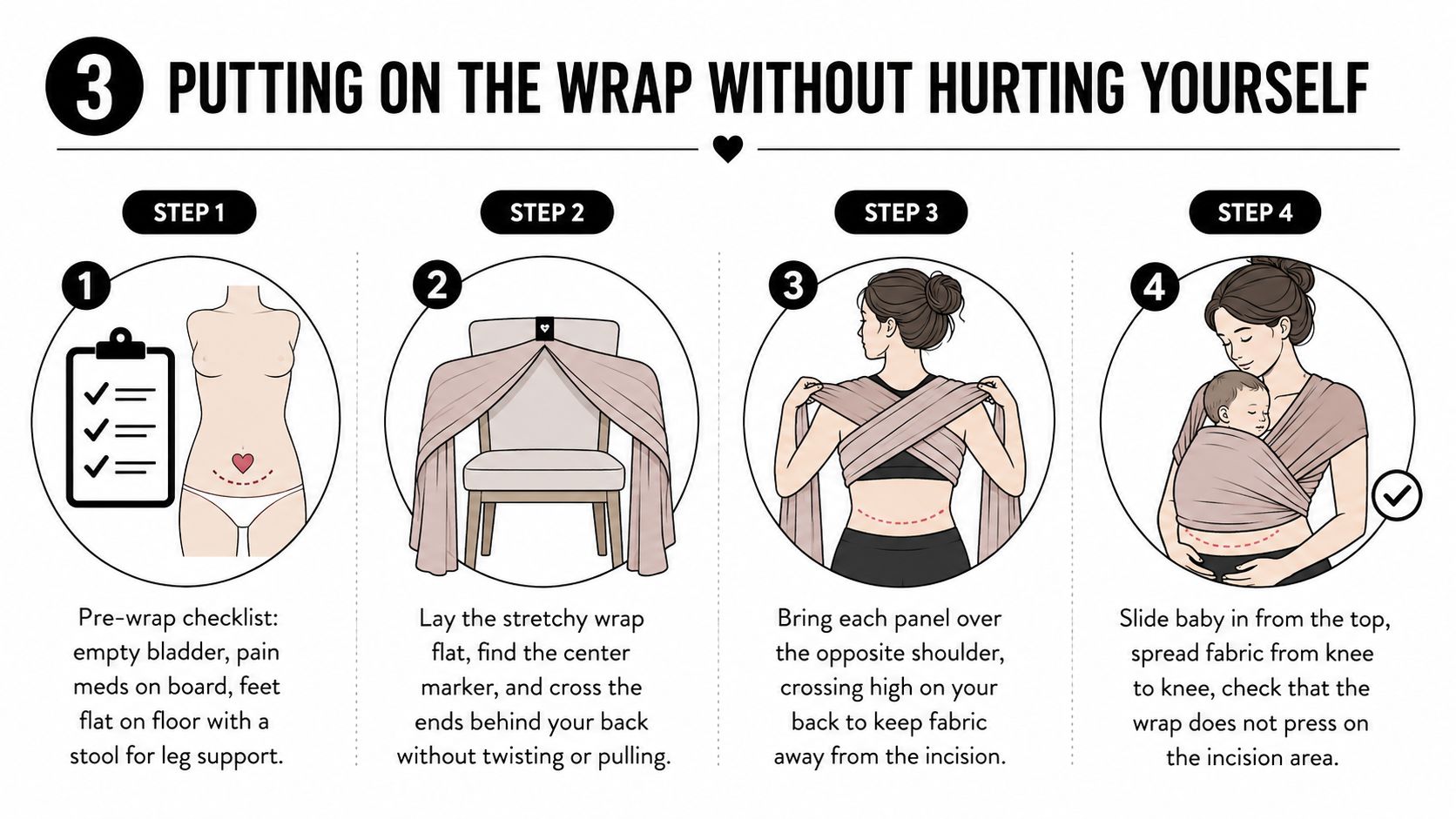
You want the baby close, but you also want your abdomen left alone. That means the wrap has to sit high, spread evenly, and stay off the scar. The goal is targeted support, not squeezing.
The setup that saves your core
Start with the boring stuff. Empty your bladder, take your pain medicine on schedule if your care team prescribed it, and sit down before you begin. Put your feet flat, keep a stool nearby if that helps your back, and don't rush the first tie.
From there, lay the stretchy wrap flat and find the center. Cross the ends behind your back without twisting hard through your torso. Bring each panel over the opposite shoulder, then keep the crossover high on your back so fabric stays away from the incision area.
The carry should feel high and shallow, not deep and low. If the fabric is dipping toward your lower abdomen, redo it. Baby should ride close enough to kiss, with support spread from knee to knee. You're aiming for snug, not crushed.
Solo or with help
If you've got a partner, let them help with the tightening. That's often easier than doing the first few tries alone while your core still feels unreliable. If you're on your own, use the couch-lean method. Sit, lean back slightly, tighten in small increments, then stand slowly and test the feel.
Use two fingers as your tension check. If you can slide two fingers into the wrap without wrestling it, you've got the right range. If you need to hold the wrap in place just to keep it from shifting, it's too loose or poorly positioned.
Your first ten minutes
Wrap, sit, breathe. Stand only when you're sure nothing is tugging at the incision. If you feel pulling, hand the baby to your partner, loosen the fabric, and try again later. That is a win, not a setback.
Breastfeeding in a Wrap After Surgery
Nursing in a wrap can feel awkward even on a good day. After a cesarean, the usual cradle hold often makes your body curl forward, and that motion can pull right where you don't want it to. Keep the feeding position simple and high, and stop trying to force a pretty setup.
The easiest options are the ones that reduce hunching. A reclined laid-back hold lets baby latch from above while you stay supported. A side-lying hold works well with pillows if sitting upright feels miserable. A slight upright football hold can also keep wrap fabric off the lower abdomen, which is exactly what you want early on.
For practical nursing adjustments, a small folded blanket can give you just enough coverage without forcing the wrap tighter. Loosen only the feeding side if you can, instead of retying the whole thing. And if your back starts rounding, reset immediately. Slumping is a fast track to more incision strain and more upper-back pain.
The detailed breastfeeding basics in these first-time mother tips are useful here, but the postpartum reality is simpler than most tutorials make it sound. Stay supported, stay high, and don't let the wrap become another thing you have to fight at 3 a.m.
If you want a nursing bra that works with that same comfort-first approach, the PETRA Nursing Bra by Milk & Lace features ultra-soft stretch lace, gentle underwire, and one-hand nursing access, which makes it a practical option once you want support that feels more polished than a sleep bra.
Red Flags and When to Stop Immediately
Tight doesn't mean effective. That's one of the most dangerous postpartum myths, especially after abdominal surgery. If a wrap feels aggressive, painful, or like it's asking your body to do too much, stop.
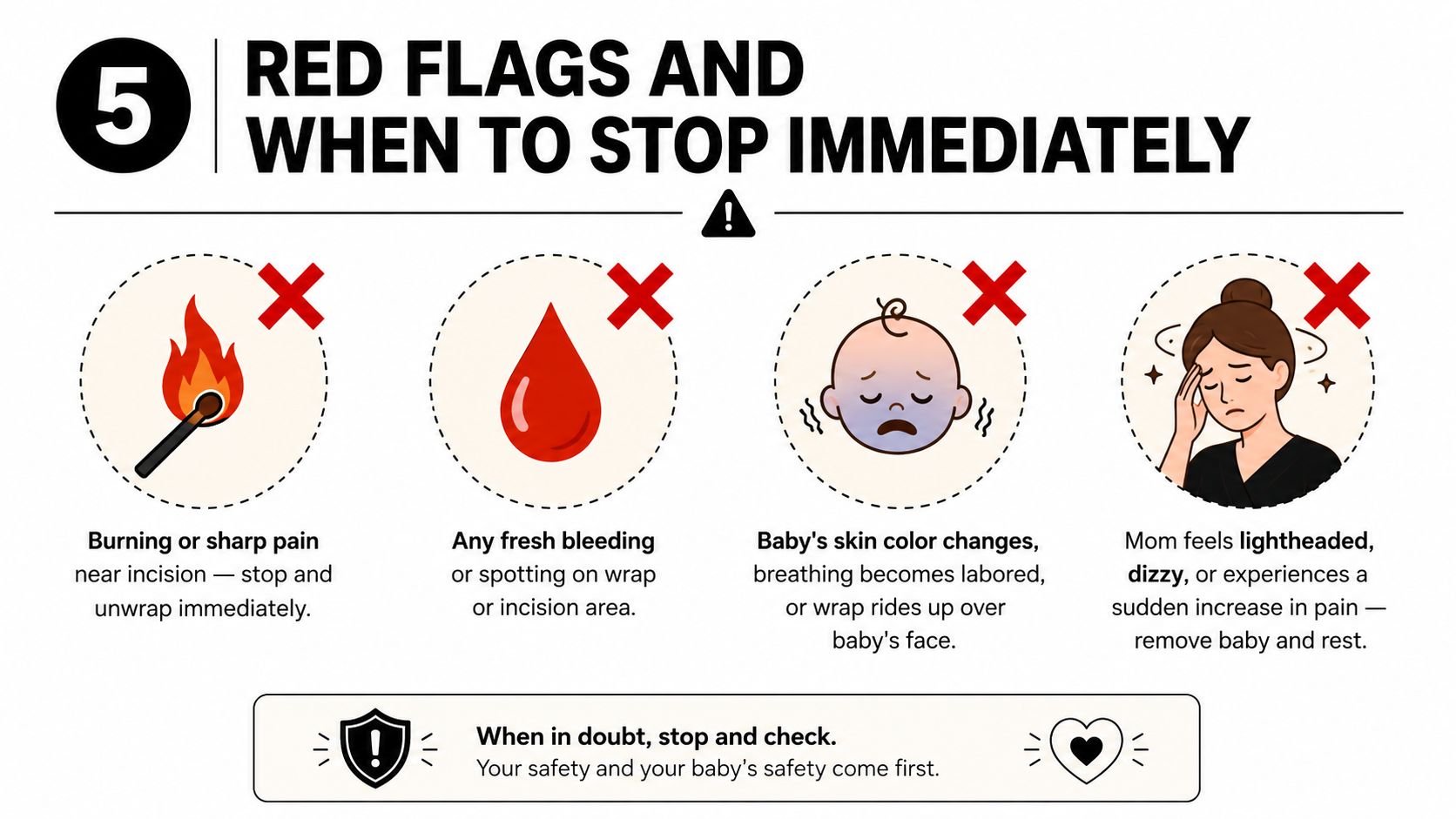
The stop-now signals are straightforward. Burning or sharp pain near the incision means unwrap immediately. Fresh bleeding, spotting, or drainage means stop and check the wound. If baby's breathing changes, the wrap rides up toward the face, or your own body starts feeling faint, that's not a “push through it” moment.
Stop first. Diagnose later.
Slow down signals
Not every problem means you can never wrap again. Sometimes the tie is off, baby is sagging, or the carry is too low. Those are adjustment problems, not character flaws.
The medical guidance around postpartum support is clear that too much compression is not the goal. Expert sources also warn against cinching too tightly or wearing support garments too long, because more pressure can make comfort worse instead of better. That warning matters more than the marketing language you'll see on product pages. A helpful plain-language reminder is covered in this article from WebMD on postpartum belly wrap use.
If the wrap keeps slipping or you keep grabbing it with one hand, pause and re-tie. If the incision area feels hot, itchy, or more tender after use, stop for the day and reassess tomorrow. Stopping is data, not defeat.
Your First Two Weeks With Baby in a Wrap
The first few days should be short and supported. Use the wrap with a partner nearby, keep sessions brief, and only stay in it as long as your body stays calm. Ignore anyone who tells you to “just get used to it.”
By days four to seven, many mothers can test solo wraps for ten to twenty minutes if the incision feels settled and walking is easier. By week two, the focus shifts to the carry that feels most natural and the rhythm that doesn't leave you sorer later. If a session makes the next day harder, scale back.
Your sleep position matters too, because a badly rested body handles everything worse. The practical sleep guidance in this C-section sleeping position guide pairs well with babywearing recovery, since better rest makes every carry feel less dramatic.
Wrapping your baby is one of the first ways you start moving through the world as a mother with a child on your body. When it feels good, it gives you more than hands-free function. It gives you a bit of yourself back.
Milk&Lace makes nursing bras for the stage when comfort alone isn't enough and confidence starts to matter again. If you want support that feels beautiful while you're healing and feeding, visit Milk&Lace and look for pieces that fit the postpartum body you have right now.